
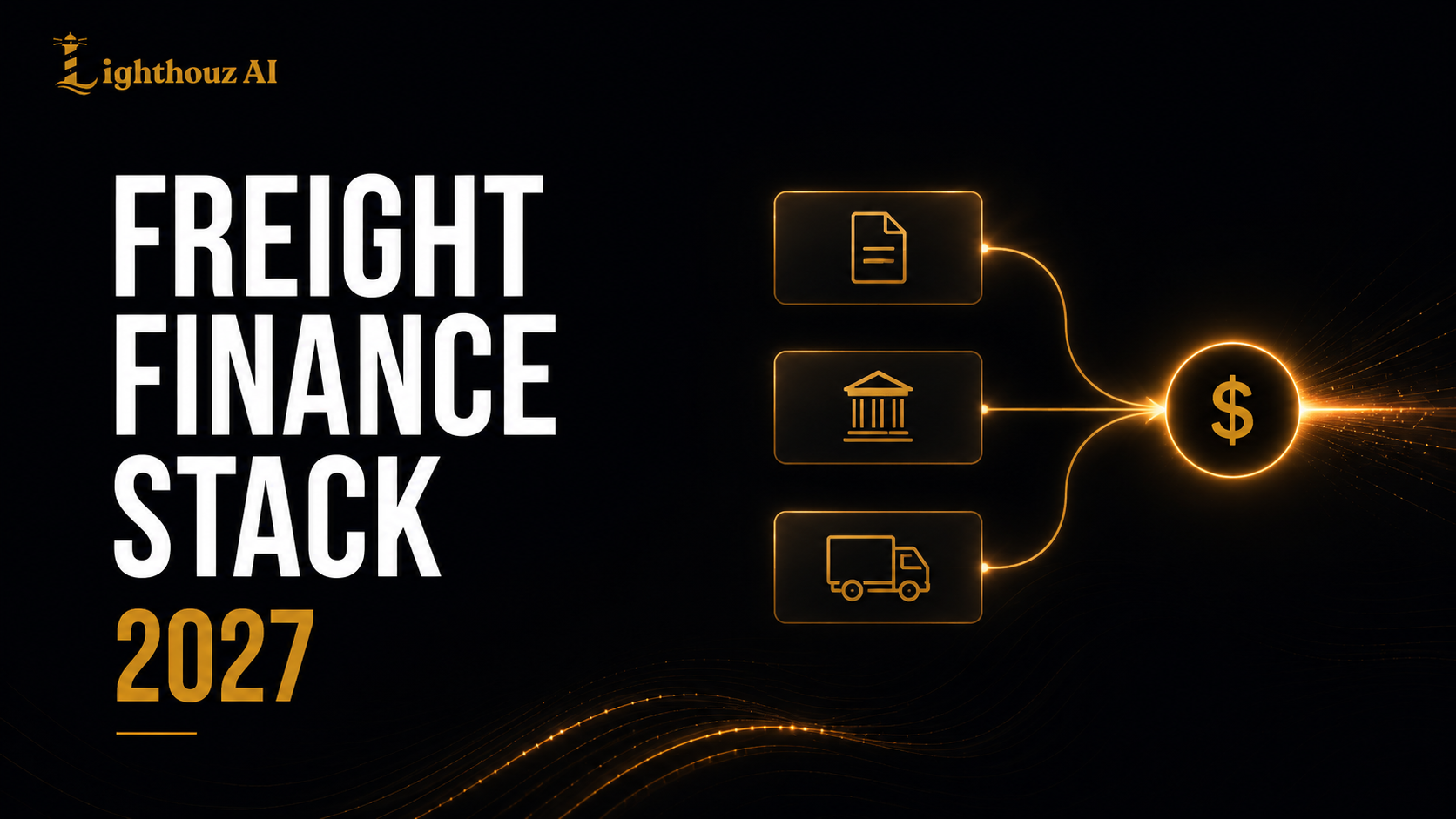
One flow.
From delivery to cash.
The TMS runs freight. The ERP records the books. A freight-native control layer makes sure invoices, bills, disputes, portals, and collections keep moving between them.
A load can be delivered on time and still take days to become a clean customer invoice. A carrier bill can reach AP and still sit untouched because the POD is missing, the fuel surcharge does not match, or a reweigh needs review. A customer invoice can be sent and still disappear inside a portal until someone logs in weeks later and finds a rejection.
None of those delays belongs neatly to one system. They live in the gaps between the TMS, accounting software, email, PDFs, shared drives, customer portals, and the people trying to keep all of them synchronized.
That is the real finance-stack problem freight CFOs are preparing to solve for 2027. Across industries, the direction is already clear: Deloitte’s Q4 2025 CFO Signals survey found that 87% of CFOs expect AI to be very or extremely important to finance in 2026, while 54% named finance agents as a transformation priority. Freight’s question is no longer whether to automate. It is where to put the execution layer so automation can safely finish the work.
The goal is no longer to digitize each finance task. It is to make the entire delivery-to-cash process move as one controlled workflow.
The Old Freight Finance Stack Records Work. It Does Not Finish It.
Most logistics companies already have the essential systems. The TMS holds the load. The accounting platform holds the receivable and payable. Email holds the conversation. Portals hold invoice statuses. Spreadsheets hold the process nobody managed to put anywhere else.
Each system may work exactly as designed. Finance still has to do the stitching.

Someone downloads the POD. Someone compares the carrier bill with the rate confirmation. Someone decides whether detention is valid. Someone creates the customer invoice. Someone submits it to the right portal. Someone follows up. Someone checks whether it was rejected. Someone updates the spreadsheet so everyone else knows what happened.
That model becomes expensive long before it looks broken. Volume grows. The team adds more people. Critical customer rules stay in the best collector’s head. Small invoices receive less attention because no single balance looks urgent. Exceptions are discovered after they have already added days to the cash cycle.
The cash gap makes every handoff matter
A brokerage can pay the carrier around Day 30 while waiting until Net 45, Net 60, or longer for shipper cash. Truckstop notes that Net 30, Net 45, and Net 60 are common shipper-to-broker terms, while carrier payment may be accelerated through QuickPay. TreviPay describes the same structural mismatch: many shippers offer Net 60 or Net 90 while carriers usually need payment within 30 days.
This is why a missing POD, late portal rejection, or disputed accessorial is not administrative noise. It extends a period during which the company has already funded the shipment but has not recovered the cash.
What the Freight Finance Stack in 2027 Actually Looks Like
The modern stack is not a rip-and-replace project. CFOs are not discarding the TMS or rebuilding the general ledger. They are adding an execution and control layer around the systems they already trust.
1. The TMS remains the operational system of record
Loads, rates, customers, carriers, shipment milestones, and supporting shipment data begin in the TMS. That context is indispensable. Generic finance automation can read an invoice; freight-native automation understands what the invoice should contain based on the load.
The distinction matters most when the work becomes messy: LTL reclasses and reweighs, accessorials, detention, lumper receipts, revised rate confirmations, duplicate bills, handwritten notes, missing signatures, and customer-specific documentation requirements.
2. Accounting and ERP systems remain the financial ledger
QuickBooks, NetSuite, Sage Intacct, and other accounting platforms should remain the source of posted financial truth. But the ledger should not be forced to act like an exception-management system, a collections inbox, or a customer-portal monitor.
The 2027 stack keeps accounting clean by validating the work before it is posted and synchronizing status after it changes.
3. A freight-native execution layer does the work between systems
This is the missing layer. It ingests documents from email, EDI, portals, and shared sources. It matches them to TMS records. It runs freight-specific audits. It creates and submits customer invoices. It monitors portals. It sends customer-specific follow-ups. It answers repetitive document requests. It routes only the exceptions that require human judgment.
At Lighthouz AI, this layer is made up of AI accountants for collections, AR invoicing, and AP bill audits. They work across FTL and LTL processes, use the company’s existing systems, and preserve an audit trail of what was checked, changed, sent, or escalated.
4. Finance leaders get one cash-control view
Aging reports are necessary, but they are backward-looking. CFOs also need to know why cash is delayed and what can be done about it now.
A connected finance stack gives leadership visibility into days to bill, invoices awaiting documents, carrier bills awaiting review, portal rejections, disputed accessorials, short-pays, customer response patterns, promised payment dates, overdue exposure, and the next action already underway.
The Stack Is Moving From Software Seats to Executed Workflows
For years, finance software was measured by access: how many users could log in, how much data could be stored, and how many dashboards could be configured. The frontier is now moving from insight to execution. C.H. Robinson reported that its generative AI agents had already completed more than three million shipping tasks. Project44’s agent portfolio similarly emphasizes exception resolution grounded in logistics context and orchestration.
The more useful question for 2027 is: what work reaches completion without a person having to notice it first?
Consider one delivered load.
In the old stack, each step creates another queue. In the 2027 stack, a clean transaction keeps moving. A person enters only when the workflow reaches a true exception: a disputed charge that needs negotiation, a relationship-sensitive escalation, an ambiguous document, or a decision outside policy.
This is why “automation” cannot mean sending more reminders or extracting more fields. A partial automation can make one task faster while leaving the overall cash cycle unchanged. The unit of improvement must be the complete workflow.
The market is still uneven. Truckstop’s 2026 Freight Broker Trends reporting says 41% of brokers are adding AI and machine-learning tools while 48% are not. That is precisely why 2027 matters: the advantage will not come from merely buying AI. It will come from connecting it to a cash-critical workflow, clear policy, and measurable outcomes.
Small balances become economically collectible
Manual collections creates a predictable bias toward the largest accounts. That makes sense for an individual collector’s day. It can be costly across the whole aging report.
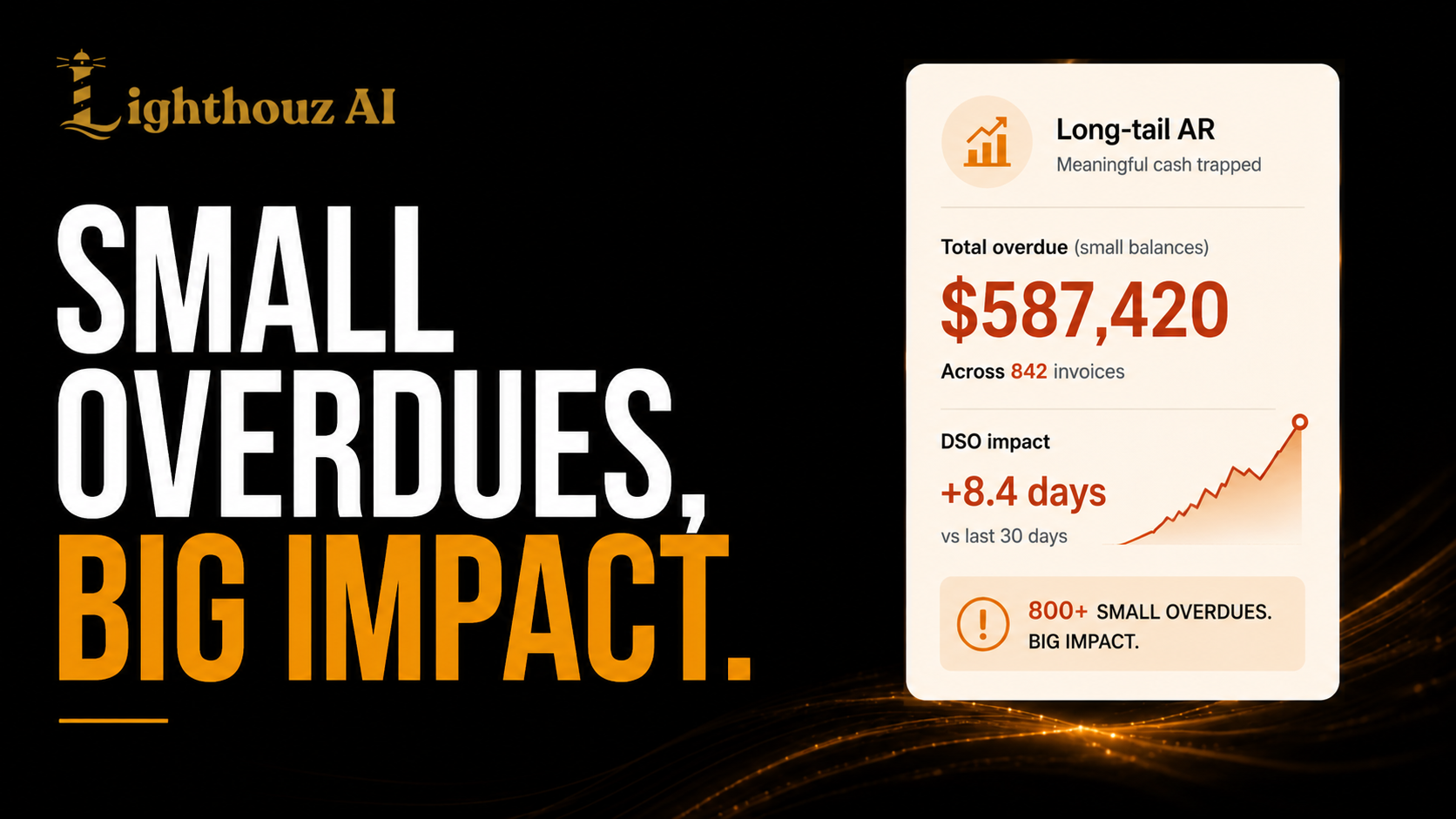
Hundreds of small overdue invoices can represent significant trapped cash, but each one is too small to justify repeated manual effort. Once routine follow-up, document resends, portal checks, and reply classification are automated, those invoices no longer compete for the same scarce human attention.
Too small to chase. Too many to ignore. The new stack changes the economics of the long tail.
Finance rules stop living in people’s heads
Every experienced AR and AP employee knows things the systems do not: which customer needs a soft reminder, which portal needs a specific backup document, which accessorial requires extra evidence, which account should be escalated, and when a carrier discrepancy is worth disputing.
When those rules remain informal, vacations and turnover become cash-flow events. The 2027 stack turns that knowledge into customer-specific cadences, audit policies, approval thresholds, document requirements, and escalation paths that continue to run when the expert is away.
CFOs Are Not Buying Autonomous AI Without Controls
The winning finance stack will not be the one that automates the most activity at any cost. It will be the one that gives finance the highest safe no-touch rate.
That requires clear controls.
- Deterministic policies: approval limits, audit checks, reminder timing, escalation rules, and required documents must be configurable and consistent.
- Confidence-based routing: routine, high-confidence work can move automatically; ambiguity should create a review task with the evidence already assembled.
- Complete audit trails: finance should be able to see what the system checked, which source it used, what action it took, and why.
- Role-based access: sensitive shipment and financial data should be available only to the right users and workflows.
- Data isolation and security: enterprise freight teams should expect encryption, controlled access, and independently audited security processes. Lighthouz AI is SOC 2 Type II compliant.
- Human control over exceptions: AI should remove repetitive work, not remove accountable finance judgment.
Do not ask, “How many tasks did AI touch?” Ask, “How much clean financial work reached completion—and how quickly did the right person see every exception?”
What Freight CFOs Should Build Now
The companies ready for 2027 will not begin with a company-wide AI transformation. They will begin with one cash-critical workflow where manual stitching is already visible.
Start with the delay, not the tool
Choose a measurable bottleneck: delivery to customer invoice, carrier bill receipt to approval, portal rejection to resolution, due date to payment, or dispute opened to dispute closed.
Baseline the current cycle time, manual touches, backlog, exception volume, and dollars affected. That keeps the project tied to working capital rather than activity.
Connect the systems already in place
The execution layer should work with the TMS, accounting platform, email, and portals the company already uses. A finance modernization project should not create another isolated source of truth.
Encode the best employee’s process
Document what the strongest collector, bill auditor, or invoicing specialist actually does. Capture customer-specific rules, escalation decisions, tolerances, required evidence, and exception paths. Those operating details are the real implementation data.
Automate the clean path first
Move standard, high-volume transactions from intake to completion with minimal human touch. Then use the exception data to expand coverage safely. This produces value early while giving finance a controlled way to learn.
Manage the stack by cash outcomes
Track days to bill, DSO, overdue dollars, no-touch processing, exception age, dispute recovery, and manual time per transaction. Headcount efficiency matters, but the larger prize is a finance operation that releases cash sooner and scales without a matching increase in administrative work.
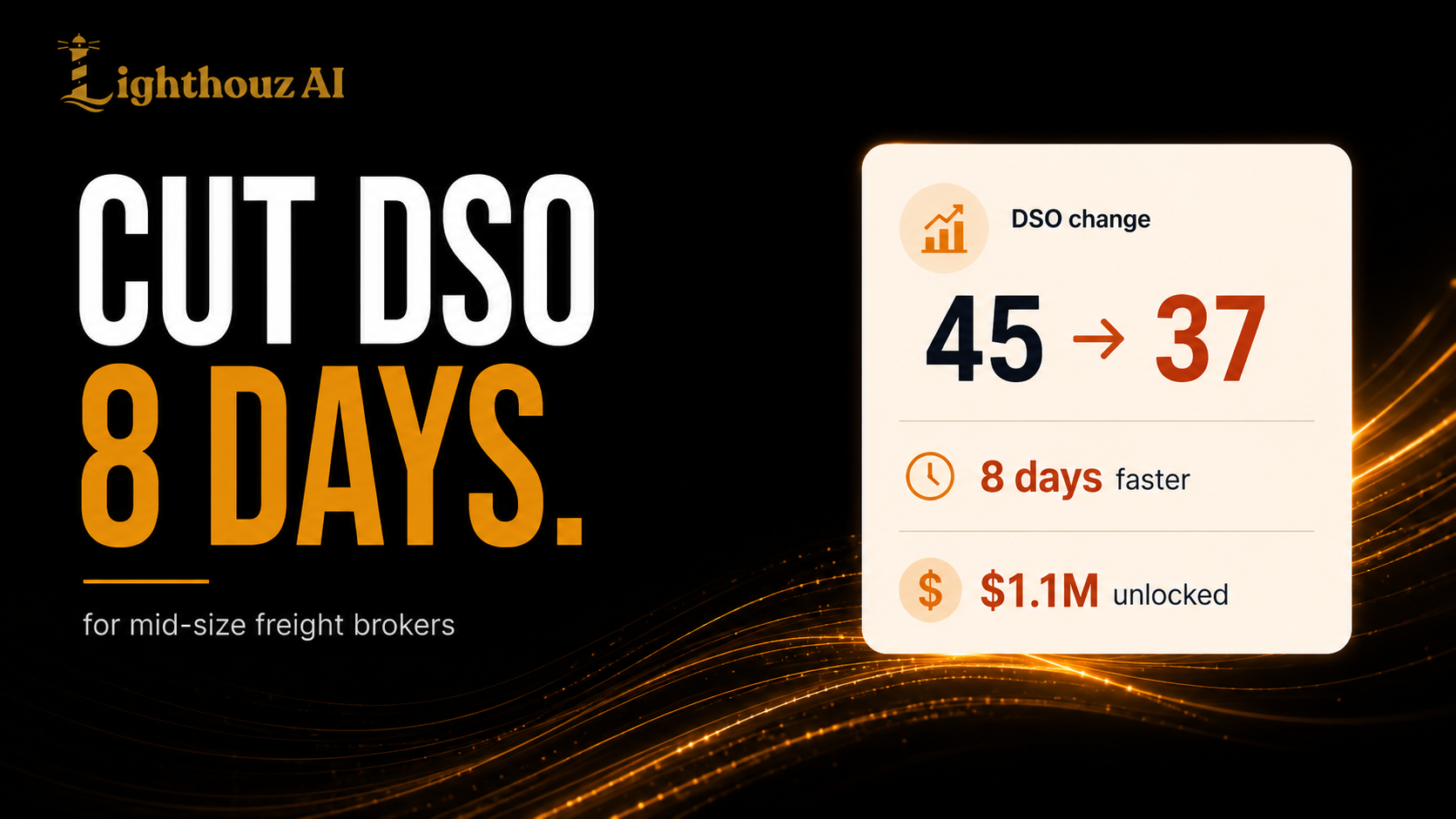
Illustrative cash released = annual credit sales × DSO days reduced ÷ 365
If a company invoices $120 million annually and sustainably lowers DSO by four days, the arithmetic implies roughly $1.32 million less cash tied up in receivables. This is an illustration, not a promised outcome; CFOs should run it with their own sales, terms, dispute rates, and cost of capital.
The freight companies that win the next decade will not simply move freight faster. They will convert every completed load into accurate, visible, collectible cash faster.
That is what CFOs are building now.
Freight Finance Stack FAQ
What is a freight finance stack?
A freight finance stack is the connected set of systems and workflows used to manage customer invoicing, carrier bills, accounts receivable, collections, disputes, payments, and financial reporting. It commonly includes a TMS, an accounting or ERP platform, communication channels, customer portals, and a finance execution layer.
Does a modern finance stack replace the TMS or accounting system?
No. The TMS remains the operational source for shipment data, while the accounting or ERP platform remains the financial ledger. A freight-native automation layer connects those systems and executes the document, audit, invoicing, collections, and exception work between them.
Where should a freight broker begin with finance automation?
Begin with a high-volume workflow tied to cash flow, such as customer invoicing after delivery, carrier bill audit, collections follow-up, or customer portal monitoring. Measure the current delay and manual effort before automating it.
How is freight-native AI different from generic AR or AP software?
Freight-native AI works with load-level context and transportation documents. It can account for PODs, BOLs, rate confirmations, accessorials, reweighs, reclasses, lumper receipts, customer portal requirements, and freight-specific disputes that generic finance tools often leave to people.
What should CFOs measure after implementation?
Core metrics include days to bill, DSO, overdue receivables, no-touch rate, exception resolution time, invoice accuracy, dispute outcomes, cash collected, and manual touches per transaction.
Research and further reading
- Deloitte, Q4 2025 CFO Signals: North American CFO expectations for 2026
- Truckstop, 2026 Freight Broker Trends: back-office technology adoption
- Truckstop, freight billing and common payment terms
- TreviPay, freight broker cash-flow timing and factoring
- C.H. Robinson, AI agents performing more than three million shipping tasks
- project44, AI agent portfolio for supply-chain execution
Build the finance stack that keeps cash moving.
Lighthouz AI is the freight-finance execution and control layer between the TMS and the ledger: bill audit, customer invoicing, portal monitoring, collections, and governed exception handling in one delivery-to-cash workflow.
Book a demo with Lighthouz AI