

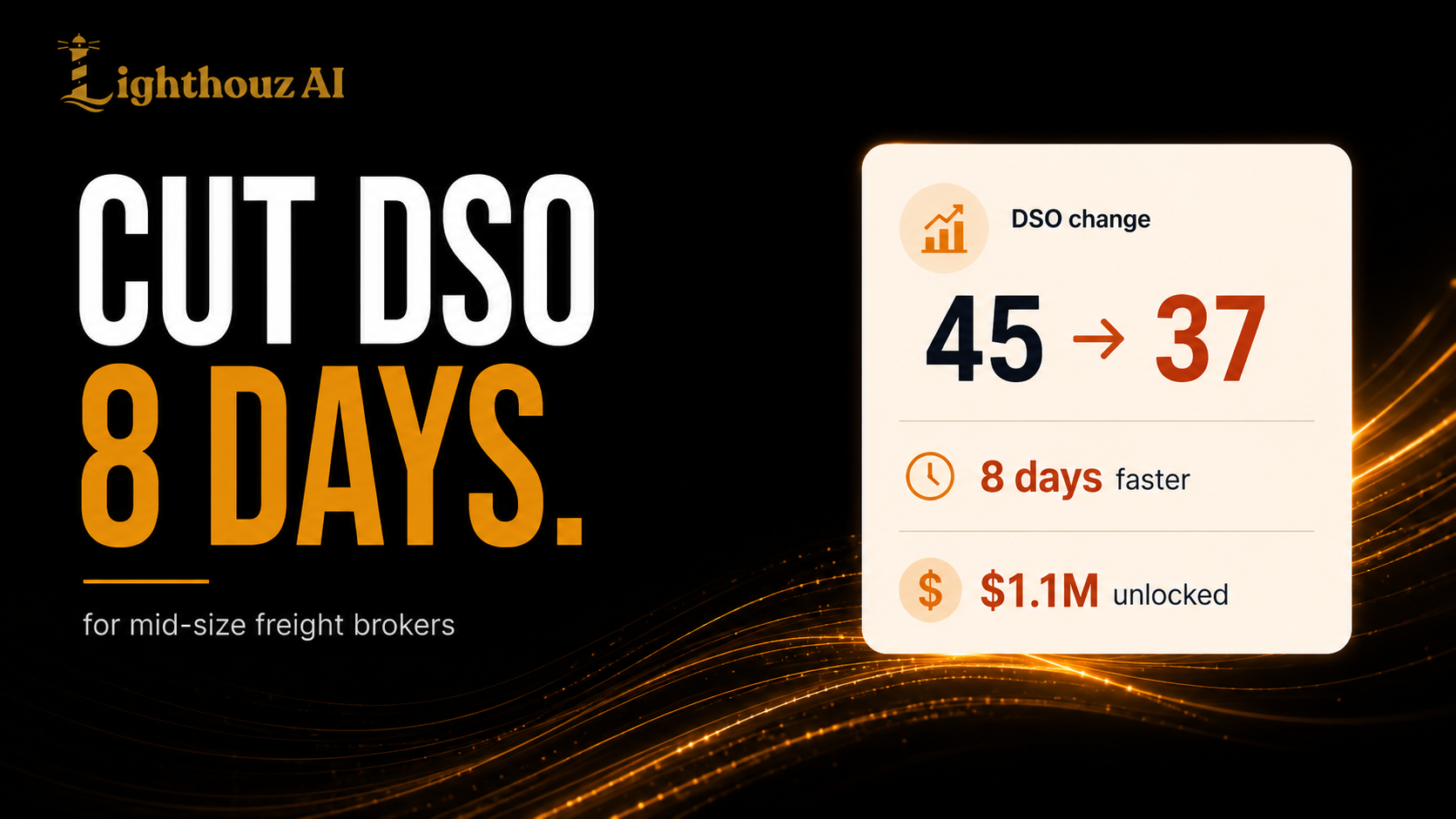
An 8-day DSO reduction is not one collections trick. It is the cumulative result of billing faster, submitting cleaner invoice packets, catching portal rejections earlier, and making every customer follow-up happen on schedule.
For a mid-size freight broker doing $50M in annual credit sales, 8 days of DSO improvement represents roughly $1.1M of working capital released without adding a collector, expanding a credit line, or selling more loads.
Example: 8 days × ($50M ÷ 365) = ~$1.1M in receivables pulled forward.
Days Sales Outstanding looks like a finance KPI. In freight brokerage, it is usually an operations KPI wearing a finance label. The formal formula is simple: DSO = accounts receivable × days in period ÷ total credit sales. The hard part is not calculating it. The hard part is finding out which invisible handoffs keep adding days to it.
That distinction matters because mid-size brokers do not usually have a pure collections problem. They have a delivery-to-cash timing problem. A load gets delivered, but the POD is not ready. The carrier invoice is in the inbox, but the accessorial backup is missing. The customer invoice goes out two days late. A portal rejects it. Nobody sees the rejection until the payment window is already slipping. The collector follows up, but the customer is not ignoring the invoice; AP is waiting for the right document.
By the time the receivable shows up as a collections issue, the first three to five days were already lost somewhere upstream.
Mid-size freight brokers cut DSO with the same finance team by automating the work between delivery and payment: document intake, customer invoicing, portal checks, exception detection, customer-specific collections cadences, and prioritized human review for invoices that actually need judgment.
Why CFOs Are Watching DSO More Closely Now
B2B payment delays are no longer edge cases. Atradius reported that in North America, average payment terms sit around 43 days from invoicing, while 38% of B2B credit sales are affected by overdue invoices and 4% are written off as bad debts. Billtrust's 2026 AR benchmark reported a 39-day DSO among its clients, a 6-day year-over-year improvement, and a 92% touchless payment rate. The signal is clear: AR teams that remove manual friction are pulling cash forward.
Freight brokers feel the pressure more sharply because their cash conversion gap is structural. Brokers invoice shippers after delivery and documentation; shipper payment terms are often Net 30 to Net 45, and sometimes longer. Transportation Management Group describes the broker process as document review, shipper invoice, then payment collection, with shipper terms commonly Net 30 to Net 45. Freight collection agencies describe the gap even more bluntly: shippers may pay in 30 to 60 days while carriers often want payment in 15 days or less.
That gap is why an 8-day DSO reduction gets a CFO's attention. It does not just improve a dashboard. It lowers the amount of cash trapped in receivables while the brokerage is still paying carriers, payroll, insurance, software, and commissions on schedule.
Where the 8 Days Actually Come From
The mistake is treating DSO as something collectors fix at the end of the month. In freight, the best DSO reduction programs start earlier. They break the time-to-cash cycle into the places where days are actually lost.
| Operational delay removed | Typical DSO impact | What changes |
|---|---|---|
| Customer invoice goes out faster | 1–2 days | PODs, BOLs, carrier invoices, and accessorial backup are captured and matched automatically so invoices are not waiting in an inbox. |
| Cleaner first submission | 1–2 days | Invoices are checked for missing documents, mismatched amounts, duplicate charges, and unsupported accessorials before the customer or portal rejects them. |
| Portal rejections caught earlier | 2–3 days | Customer portals are monitored continuously, so rejected or short-paid invoices are surfaced the same day instead of after a collector remembers to log in. |
| Consistent follow-up on every account | 1–2 days | Customer-specific reminders go out before and after due dates, including the right invoice context and supporting documents. |
| Human collectors work the right exceptions | 1 day+ | The team stops scanning the entire aging report and instead works prioritized cases by amount, age, risk, and missing action. |
Portal rejections deserve special attention because they are the row with the most room to swing. When nobody is watching the portal, a rejected or short-paid invoice does not just sit for a day; a rejection can sit unseen for weeks, quietly stretching DSO. In one automation case study documented on that same analysis, cutting invoice rejections by 23.5% also cut billing time by 66% and lowered true DSO by 21% — evidence that portal blind spots are a real, measurable driver of days added to DSO, not just a theoretical one.
Put together, those changes create a practical 6-to-10-day DSO improvement range. Eight days is not aggressive when the starting point includes delayed billing, customer portal blind spots, manual POD matching, and inconsistent collections cadences. It is a realistic target for brokers whose finance team is already doing the work, just too manually.
Why Mid-Size Brokers Feel This More Than Enterprise 3PLs
Large 3PLs can sometimes absorb process inefficiency with specialized teams: billing, POD collection, credit, cash application, deductions, collections, and portal management all sit in different swimlanes. Mid-size brokers rarely have that luxury. The same finance team is often approving carrier payables, sending customer invoices, chasing PODs, fixing accessorial disputes, monitoring customer portals, applying payments, and answering customer AP questions.
That is why adding revenue can quietly make DSO worse. More loads create more documents. More shippers create more portals. More accessorials create more exceptions. More exceptions create more inbox work. The finance team does not need to be underperforming for DSO to drift upward; it only needs to be operating at the edge of its manual capacity.
The industry is already moving in that direction. Truckstop reported that more than 40% of brokers plan to deploy AI or machine-learning productivity tools in 2026, while 48% are not planning to adopt them yet. That gap matters. The early movers are not just buying AI. They are deciding that back-office throughput is now a margin and working-capital lever.
The Old Model: Sort the Aging Report and Hope the Team Gets to It
Most freight broker collections processes still start too late. A collector opens an aging report, sorts by balance or days past due, and begins working the obvious problems. Big balances. Angry customers. Invoices finance leadership asked about. The process feels rational because the collector is using scarce time on the most visible dollars.
But DSO does not care only about the obvious dollars. It also cares about every invoice that was sent two days late, every $800 accessorial that got short-paid because the detention log was not attached, every customer portal rejection that sat untouched for a week, and every Net 30 invoice that got its first real follow-up on day 42.
The old model can be summarized in one sentence: the team finds problems after they have already become aging problems.
The New Model: Run Delivery-to-Cash Like an Operating System
A freight-native DSO reduction program treats every load as a mini cash-conversion cycle. It does not wait for the invoice to age. It starts as soon as the load is delivered.
| Workflow | Manual finance team | AI-assisted finance team |
|---|---|---|
| Document intake | PODs, BOLs, receipts, and carrier invoices arrive across inboxes and portals | Documents are captured, classified, matched to the right load, and checked for missing proof |
| Customer invoicing | Invoice waits until someone assembles the packet | Clean invoice packets are prepared automatically after delivery |
| Accessorial disputes | Collector asks ops for backup after customer rejects the charge | Detention logs, reweigh certificates, lumper receipts, and BOL proof are attached before follow-up |
| Portal monitoring | Collectors log in when they have time | Portal statuses, rejections, short-pays, and missing-document cases are checked continuously |
| Collections cadence | Follow-up depends on workload and memory | Customer-specific reminders run before due date, on due date, and after due date |
| Human review | Team scans spreadsheets and inboxes | Team sees a prioritized queue by amount, age, customer risk, and required action |
This is where generic AR automation and freight-native collections split apart. A standard AR tool can send reminders. That helps. But freight invoices often stall because something freight-specific is missing or disputed: a signed POD, a BOL, a lumper receipt, a reweigh certificate, a detention log, a rate confirmation, a carrier bill mismatch, or a customer portal field. The reminder is useful only if it carries the proof needed to resolve the hold.
What Appeals Most to CFOs and Controllers
CFOs do not buy “AI collections” because the phrase sounds modern. They buy it when the operating model answers four questions with numbers.
| Decision-maker question | What the blog/page should answer |
|---|---|
| How much cash can we pull forward? | Show cash unlocked from DSO improvement: DSO days reduced × average daily sales. This turns automation into working-capital impact. |
| Can we grow without another AR hire? | Show invoices per finance FTE, no-touch follow-up rate, portal coverage, and exception volume per person. |
| Where is DSO actually getting stuck? | Break DSO into controllable operational drivers: days to bill, portal rejection age, dispute cycle time, and average days delinquent. |
| Will this create customer noise? | Show customer-specific cadence controls, document-backed follow-ups, escalation rules, and human approval for sensitive accounts. |
| How do we know it is working? | Track DSO, CEI, ADD, % current AR, dispute rate, first-pass invoice acceptance, and customer portal rejection age. |
This is also why the pitch should not be “replace your collectors.” The stronger CFO pitch is: keep the same finance team, remove the manual work that prevents them from controlling cash.
The KPIs That Actually Prove DSO Is Improving
DSO is the headline metric, but it is not enough by itself. Salesforce notes that a higher DSO suggests slower collections and possible cash-flow strain. TreviPay recommends monitoring DSO alongside metrics like CEI, current AR, dispute rate, and write-offs, and uses a simple cash-unlocked formula to quantify liquidity impact. AFP similarly frames DSO as a key indicator of cash flow and liquidity, with companies generally aiming below 45 days depending on industry and terms.
| KPI | Why CFOs/controllers care | What good movement looks like |
|---|---|---|
| DSO | Headline measure of how quickly revenue turns into cash. | Downward monthly or quarterly trend. |
| Average Days Delinquent (ADD) | Shows how late customers are beyond agreed terms. | Lower ADD, especially in top customer cohorts. |
| Collection Effectiveness Index (CEI) | Shows how much collectible AR was actually collected. | Higher CEI, ideally above 90% for mature teams. |
| Days to Bill | Measures internal billing lag before the customer payment clock even starts. | Move from multi-day delay to same-day or next-day invoicing. |
| First-Pass Invoice Acceptance | Measures whether customer invoices are accepted without rejection or missing documentation. | Higher acceptance rate, fewer rejected packets. |
| Portal Rejection Age | Measures how long portal problems sit before finance sees them. | Hours, not days. |
| Dispute Cycle Time | Measures how long accessorial, detention, reweigh, and short-pay disputes take to resolve. | Shorter cycles with document-backed responses. |
| Invoices per Finance FTE | Shows whether revenue growth is creating back-office headcount inflation. | More invoices handled per person without aging deterioration. |
A 90-Day Plan to Cut DSO Without Adding Finance Headcount
Days 1–15: Baseline the real delay
Start with the aging report, but do not stop there. Segment DSO by customer, invoice type, dispute reason, portal requirement, and days to bill. Calculate average days between delivery and customer invoice. Calculate average age of unresolved portal rejections. Pull a sample of short-paid accessorials and ask what proof was missing when the customer disputed them.
The goal is to separate customer payment behavior from internal process lag. If a customer pays 35 days after invoice, but the invoice goes out 4 days after delivery, the real delivery-to-cash timeline is 39 days. Finance cannot negotiate terms until it first controls its own clock.
Days 16–45: Automate the repeatable work
Automate the steps that do not require judgment: document capture, POD matching, invoice packet assembly, customer-specific reminders, portal checks, status updates, and routine payment follow-up. This is where the same finance team starts getting leverage. Every invoice is touched on schedule, including the small ones. Every portal is checked, not just the customers someone remembers. Every reminder carries the right invoice context.
Days 46–90: Move humans to exception control
Once the routine work is automated, the finance team should spend its judgment on the cases where judgment actually moves cash: high-dollar accounts, disputed accessorials, repeated short-pays, chronic portal rejections, customer-specific approval bottlenecks, and invoices approaching aging thresholds.
This is the operating difference between “more collections activity” and “lower DSO.” The former creates noise. The latter creates controlled cash movement.
Where Lighthouz AI Fits
Lighthouz AI is built for the part of freight AR where generic tools usually stop: the freight-specific work behind the invoice. It helps brokers automate delivery-to-cash workflows across AR, AP, and collections so the finance team can invoice faster, monitor customer portals, attach the right proof to disputed charges, answer routine customer AP questions, and prioritize the exceptions that require a human.
For a CFO, the value is not “AI sent emails.” The value is that the payment clock starts sooner, fewer invoices get rejected, fewer disputes sit undocumented, and collectors stop spending their day searching for the status of work that software should already know.
Frequently Asked Questions
Can a freight broker really cut DSO by 8 days without hiring?
Yes, if the current DSO includes internal delay. The fastest gains usually come from reducing days to bill, eliminating missing-document rejections, catching portal issues earlier, and making customer follow-up consistent. Hiring more collectors may help if the team is severely understaffed, but it does not solve the root problem if invoices are late, incomplete, or invisible inside portals.
How do you calculate the cash impact of DSO reduction?
Use this formula: DSO reduction × average daily credit sales. A broker with $50M in annual credit sales has about $137,000 in daily sales. An 8-day DSO reduction pulls forward about $1.1M in working capital. The same formula works at any size: a $25M broker unlocks roughly $548,000 from an 8-day reduction; a $100M broker unlocks roughly $2.2M.
Why is freight broker DSO different from normal B2B DSO?
Freight broker DSO is tied to freight-specific proof. Customers do not always delay payment because they lack willingness to pay. They delay because invoice packets are missing PODs, BOLs, lumper receipts, detention logs, reweigh certificates, or portal-required fields. A generic collections reminder does not fix that; a document-backed workflow does.
What should a controller automate first?
Start with the work that is high-volume, rules-based, and directly tied to payment timing: POD matching, invoice packet assembly, missing-document detection, portal monitoring, pre-due reminders, post-due follow-ups, and aging queue prioritization. Leave customer escalations, credit-risk decisions, and strategic account conversations to humans.
What is the difference between AR automation and freight-native collections automation?
AR automation usually focuses on reminders, payments, cash application, and reporting. Freight-native collections automation also understands freight documents, accessorial disputes, carrier bill mismatches, customer portals, POD requirements, and the relationship between AP delays and AR delays. That freight context is what allows the system to resolve the reason an invoice is stuck, not just remind someone that it exists.
See Where 8 Days Are Hiding in Your DSO
Most mid-size brokers do not need a larger finance team to improve DSO. They need a clearer map of where cash gets stuck between delivery and payment.
Book a demo with Lighthouz AI and see how much working capital is trapped in delayed billing, customer portal exceptions, missing documents, and manual follow-up.